
NEW RULES FOR INVESTMENT LENDING AS OF 1 FEBRUARY
Updated: Feb 13

Property investors have rarely been busier – or more heavily geared.
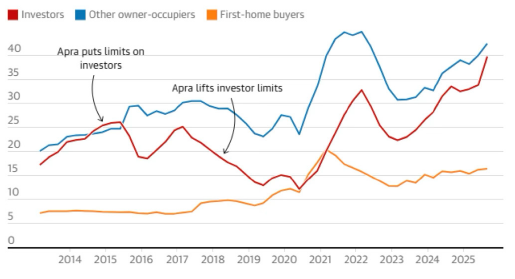
In the September 2025 quarter, investors made up roughly two in every five new home loans, even as first home buyer activity fell away and house prices continued to surge across much of Australia.
The Australian Bureau of Statistics confirmed in December that investor lending reached record levels, intensifying pressure on the Albanese government to rein in landlord credit and consider tougher settings for banks that are aggressively funding investment activity.
This divergence – investors charging ahead while would be first home buyers retreat – is reshaping the housing market and reigniting long running debates about fairness, financial stability and the role of credit policy in driving prices.
Against a backdrop of stretched affordability and rising investor dominance, calls are growing for new rules that could fundamentally change how portfolio builders access finance and scale their holdings.
Investors returning to 2014-era dominance
Value of new loan commitments ($bn) by type of
borrower, quarterly

What’s coming?
Australian property investors now face a very different lending landscape, with new APRA rules capping high debt to income (DTI) lending at the same time governments are ramping up high leverage schemes for first home buyers.
The net effect is a more constrained environment for growth focused investors, even as policymakers actively encourage highly geared entry into the market for new buyers.
What APRA’s new DTI cap actually does
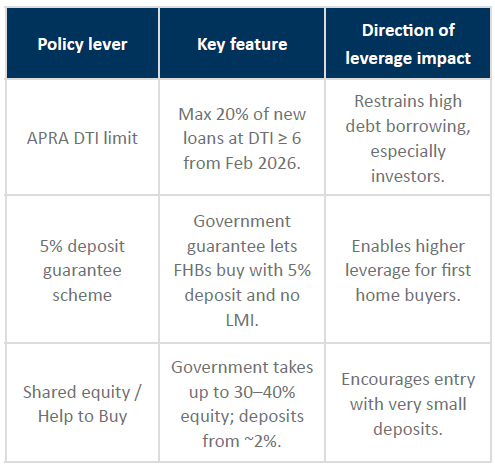
From 1 February 2026, APRA will limit banks so that no more than 20% of their new mortgage lending can go to borrowers with a DTI of six times income or higher. This cap is measured separately for owner occupiers and investors, and applies to authorised deposit taking institutions (ADI) - the major banks and most mainstream lenders. However these limits will not apply to non bank lenders.
APRA’s own commentary makes it clear the move is about preemptively containing a build up of riskier, high DTI lending, especially to investors and protecting the resilience of both the banking system and households.
In practice, once a bank is getting close to that 20% high DTI quota, credit teams are likely to ration their remaining ‘slots’ for the highest quality or most profitable borrowers, who can leave leveraged investors at the back of the queue.
Why active investors are nervous
Investors tend to operate at higher DTIs than owner occupiers because each additional property layers on more debt relative to income, particularly in markets like Sydney, Brisbane and Melbourne where price growth has outpaced wages.
That means portfolio builders – the ones already at four, five or six properties – are precisely the group most likely to run into the new hard limits, even if they have strong repayment histories and solid buffers in place.
The concern is less that high DTI loans will disappear altogether and more that access becomes inconsistent and policy driven. For example, one bank might ‘run out’ of high DTI capacity in a quarter and simply stop approving marginal deals, while another stays open but only for very tightly structured applications.
How APRA’s DTI cap and government schemes push in opposite directions
THE CONTRADICTION
Tighter rules vs high leverage schemes
On one hand, APRA is leaning on the brakes by targeting high DTI lending, particularly to investors whose borrowing is growing fastest. On the other hand, the Australian Government is simultaneously expanding schemes that explicitly lower deposit hurdles – such as the 5% deposit guarantee and new shared equity programs – to pull more highly leveraged first home buyers into the market sooner.

The expanded 5% deposit guarantee from October 2025 allows eligible first home buyers to purchase with as little as 5% down while avoiding lenders mortgage insurance, with the government effectively underwriting part of the risk.
Shared equity programs such as Help to Buy go even further, allowing deposits from around 2% where the government takes up to 40% ownership (depending on the property) in exchange for a smaller mortgage and reduced repayments, but still embedding households in a highly geared position relative to their savings and income.
CRITICISM, IRONY AND THE RISK OF OVER GEARING
Commentators have been quick to point out the irony…
APRA is clamping down on high DTI lending in the name of systemic stability, while government schemes are explicitly designed to put low buffer households into the market with minimal equity at stake.
Industry voices have raised concerns that if property values soften or unemployment ticks up, recent buyers using 2–5% deposits could find themselves in negative equity faster than investors who have accumulated more substantial buffers over time.
There is also a growing debate about whether these schemes are solving affordability or simply pulling demand forward and bidding up entry level stock, particularly in markets where price caps sit near typical median values.
The combination of low deposits, tight price caps and varying lender policies can leave first home buyers with fewer real choices than they expect and could expose them to stress if interest rates stay higher, or even increase, for longer than anticipated.
BANKS ARE PULLING BACK FROM TRUSTS AND COMPANIES
What investors should do
Against this backdrop, many major lenders have been quietly tightening their approach to more complex structures such as discretionary trusts and company borrowers. They are applying stricter income assessments, higher interest rate buffers, and more conservative treatment of potential tax benefits like negative gearing compared to standard PAYG borrowers.
Because of this uncertainty, lenders may choose to only partially recognise or sometimes exclude the expected tax benefits from their loan serviceability calculations. Instead of assuming the full tax refund will be available or consistent every year, they may apply a haircut - acknowledging perhaps only a portion of those benefits as effective income.
They might also factor in higher interest rate buffers or ‘stress test’ scenarios that assume rising rates or falling valuations, that may further reduce the perceived income benefit from negative gearing.
Combined with the DTI cap, that means sophisticated investors who have relied on trusts and corporate structures for asset protection and tax planning may find their borrowing capacity materially reduced with mainstream banks over the next lending cycle.
For investors determined to keep growing, the priorities now are to:
stay ahead of policy changes
work closely with our experienced finance team who understands how each lender treats DTI and complex structures
AND
remain flexible enough to adapt as alternative and nonbank options evolve

Nonbank and specialist lenders are not directly bound by APRA’s DTI cap, however they price for risk, so investors need to weigh higher rates and fees against the strategic value of that extra property and build in conservative buffers so the portfolio still makes sense when the economic tide turns.
For investors scaling portfolios, stay vigilant on APRA and ABS updates. Team up with our finance specialists who live and breathe lender policies and can build buffers into your strategy that prepare you for potential rate hikes or policy curveballs.
As banks tighten on trusts and alternatives rise, flexibility
is your edge.
If you'd like help with assessing your personal and financial situation, as well as comparing the loans in the market to see if you're truly getting the right deal for you, then call Bob Malpass now on 0431 862 136, email bob@westhomeloans.com.au


